 Layoff Decoded
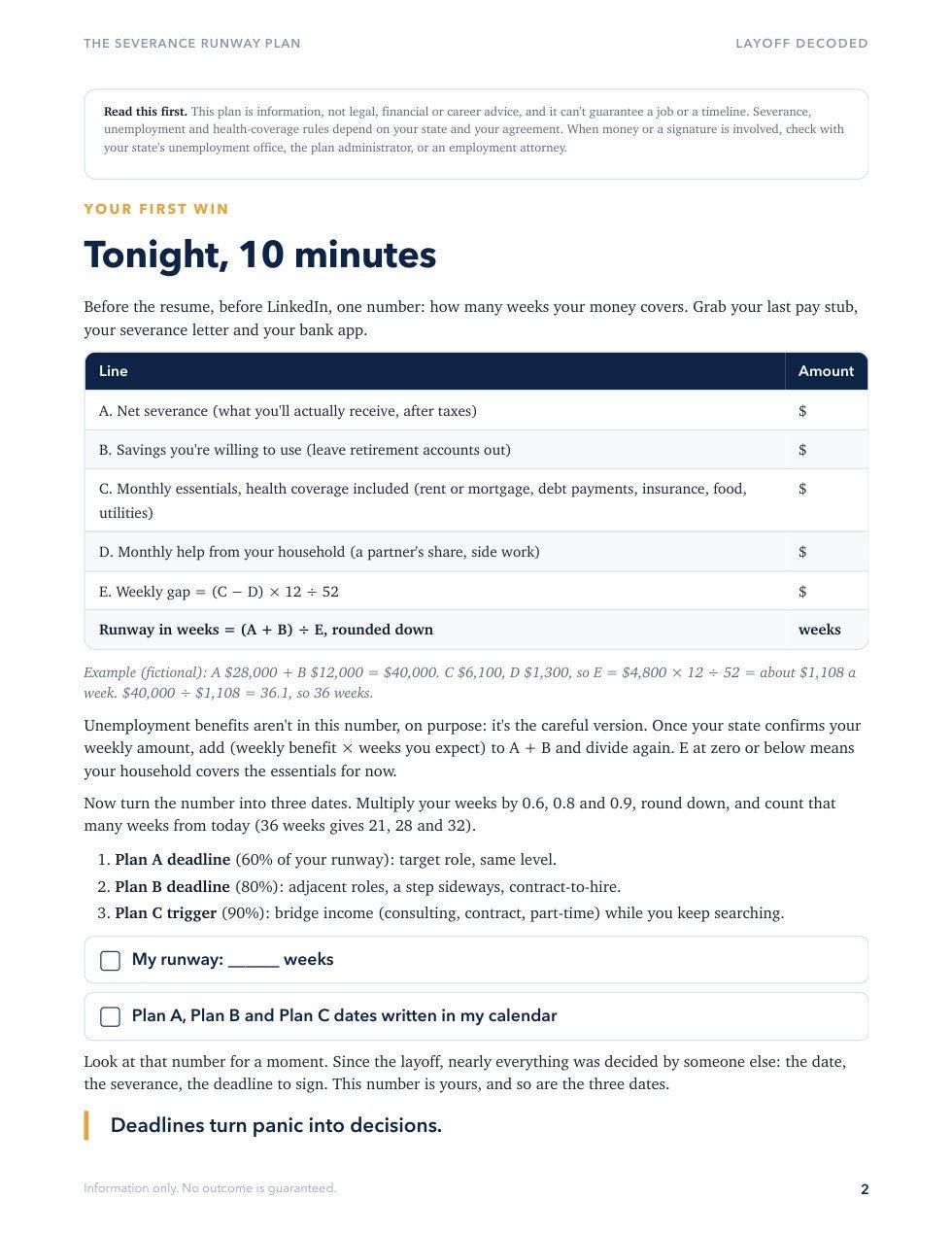
FreeTonight, 10 minutesYour number of weeks
3 a.m. Twenty years, eight weeks of severance. You run the math again.
The Severance Runway Plan puts that math on paper in 10 minutes tonight: one number of weeks, three dates, and the 3 a.m. question finally has an answer. Free, 9 pages, for US professionals laid off after 10 to 20+ years. Your resume can wait until day 4.
“Now I'm the guy refreshing LinkedIn.”
Posted on Reddit by a man laid off at 52 after 20 years in cybersecurity, October 2026.
3 a.m.
If this is your week, you know the 3 a.m. version: the jaw already tight before you're properly awake, the numbers running on their own. Severance, minus the mortgage, minus whatever COBRA turns out to cost.
“How long can we actually last?”
You lose the count somewhere in month two and start over.
The daytime version looks like this:
Tick what's true this week. Nothing is saved or sent.
People in your spot have said the rest better than we could. One called twenty years at a company “a marriage.” Another wrote, “it's like I'm grieving … I feel frozen.” And someone who had finally found work again wrote the line we'd want you to keep:
“It's your struggle but it's not your fault.”
Then start with what you can hold: three dates that began running on your last day.
Three clocks started on your last day
Nobody announces them. They run while you update your resume and while you wait to feel ready, and a week of waiting costs a week on all three.
21 or 45 days, then 7
The severance agreement
“8 weeks for 20 years service should be criminal,” someone wrote under a 58-year-old's layoff post. Whatever your number is, the signature on it has a deadline. If you're 40 or older and the agreement asks you to give up age-discrimination claims, federal law (the OWBPA) generally gives you at least 21 days to consider it, or 45 in a group layoff, then 7 days to take your signature back. Those days count down whether the envelope is open or not. Confirm your own dates with an employment attorney.
60 days
Your health coverage
You generally have 60 days to elect COBRA, and losing job-based coverage normally opens a 60-day window to buy a plan on HealthCare.gov. One person on Reddit wrote that COBRA would cost them “literally $800/month.” That's their number, not an average, and it's the reason to compare both options before the window closes.
? weeks
Your runway
The week your money stops covering your bills. This one doesn't come with a letter, so you only know the date if you work it out, which takes about 10 minutes. One person who searched for six months wrote, “I was about 2 weeks away from withdrawing from retirement.”
Sources: U.S. EEOC, waivers for workers 40+U.S. Department of Labor, COBRAHealthCare.gov, special enrollment period.
The advice you're getting was written for a 24-year-old
"Fix your resume first."
"Just network."
Most of that advice was written for 24-year-olds sending 500 applications, with no mortgage and nothing to sign. The man refreshing LinkedIn at 52 called “just network!” “advice I want to throw out a window,” and a reader of one job-search book said it “felt more targeted to people just getting into the job field than it did for people who have been working in a career for some time.”
After a long career, the order changes, and the plan puts it in order, starting tonight:
- 1Tonight, 10 minutesYour number of weeks, and three dates in your calendar.
- 2The first 72 hoursThe deadlines you can't undo, protected before anything else.
- 3Your 30-second answer to "why did you leave?", ready to say out loud.
- 4Then the resume and LinkedIn fixes, and three messages already written, so you talk to people who know your work before you send a single application.
People who have seen you work can vouch for twenty years that a resume squeezes into two pages. A screening tool only reads the two pages, or as one man described applying cold: “You submit an application into an ATS black hole, an AI screener decides you're not a match, and no human ever sees it.”
Your runway in 30 seconds
Four numbers, and rough ones are fine. It takes less time than the math you redo in your head at 3 a.m., and it runs in your browser, so nothing you type is sent or saved.
What's in the plan
Tonight, then 6 parts9 pages (15 on a phone)
- 1Tonight, 10 minutes. Your first win: how many weeks your money covers, and three dates in your calendar, Plan A, Plan B and Plan C. In the plan's words, “Deadlines turn panic into decisions.”10 min
- 2The first 72 hours. What to check in the severance agreement before you sign, COBRA or the Marketplace, filing for unemployment, and the proof of your work to save before your access disappears.72 h
- 3Your 30-second answer to “why did you leave?” Fact, proof, forward, practiced out loud until it sounds boring.30 sec
- 4Your 20 warm contacts, sorted into four lists, with 3 messages to copy that each make one clear ask.20 names
- 5Five resume fixes for experienced pros, starting with two: detail only the last 15 years, and remove graduation years.5 fixes
- 6LinkedIn in 20 minutes: a headline formula, an About section in three short paragraphs, and “Open to Work” set to recruiters only.20 min
- 7Then a day-by-day checklist: one task and its time for each day, from 20 to 60 minutes, and a weekly scorecard that counts the conversations you start.1 line a day
Who it's for
If you were laid off in the US after 10, 15, 20 years or more, or you've been given the date your role ends, this plan was written for you. You're good at the work. Maybe you're in the same spot as the person who wrote, “I haven't looked for a job in over 25 years.”
Who it isn't for
A first job search, or someone a few years into a career: most of it still applies, but it wasn't written for you. And anyone outside the US, because the severance, unemployment and health-coverage rules in it are American.
Tonight, the fog turns into dates
Ten minutes from now, the fog on the calendar can turn into three dates, written in pen. When someone at dinner asks how it's going, you answer with a number of weeks and a plan, and the table doesn't go quiet afterward. “So why did you leave?” gets a calm 30-second answer you've said out loud five times. Some nights you sleep straight past 3 a.m. That's what the plan is for.
Is it really free?
Yes. There's no card to enter and nothing to cancel. The PDF comes by email, and the next page has a link to download it right away.
Why do you need my email?
To send you the plan and five short emails, one a day for five days, each with one task from the plan. From the second email on, each one also mentions our paid Playbook. We don't sell or share your email address (Brevo sends our emails, Whop processes payments). Every email has a one-click unsubscribe link.
What's in the 5 emails?
Day 0: the plan, and where to start (your runway). Day 1: a structure for answering “why did you leave?” Day 2: why to stop applying for 48 hours, and the 3 messages to send instead. Day 3: two resume details that signal age, and the Playbook. Day 4: a quick check against your scorecard.